
Token-Gated Discounts vs Loyalty Programs: What Actually Wins?
The Insumer Model™ · February 2026

You’re spending $200/month on a loyalty program that 80% of your customers ignore. Token-gated discounts tap into existing communities of millions, cost pennies per interaction, and come with a built-in marketing army. Here’s the honest comparison.
If you run a business, you’ve probably tried loyalty programs. Punch cards. Points systems. Apps that send push notifications nobody reads. And you’ve probably noticed the pattern: initial excitement, declining engagement, and eventually a graveyard of unused rewards sitting in a database somewhere.
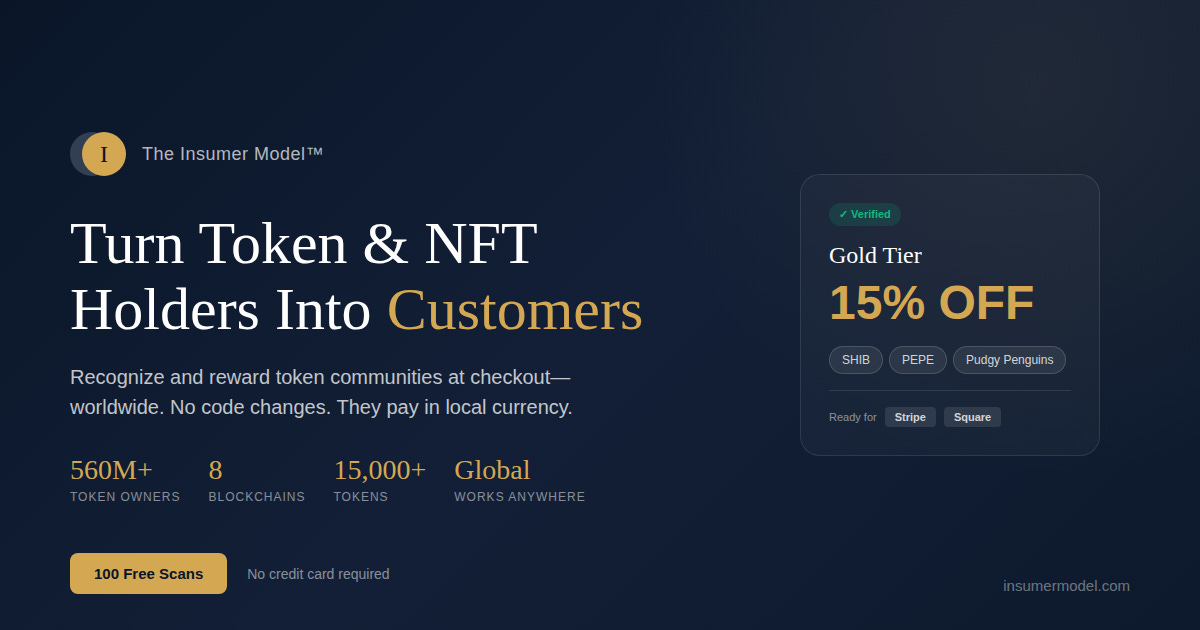
Token-gated discounts are a fundamentally different model. Instead of building loyalty from scratch, you recognize existing communities who already self-identify and actively seek businesses that acknowledge them. Let’s break down how the two approaches compare across every dimension that matters.
Setup Cost
Traditional loyalty: Most loyalty platforms charge $50-300/month. Custom apps cost $5,000-50,000 to develop. Even a simple punch card system requires printing, staff training, and ongoing management. Then there’s the cost of the rewards themselves — free items, points redemptions, and discount margins.
Token-gated discounts: Free to start. The Insumer Model includes 100 free scans. After that, 500 scans cost $20. That’s $0.04 per customer interaction. No app development. No cards to print. No points system to manage. Setup takes about 5 minutes through a web dashboard.
Customer Acquisition
This is where the comparison gets stark.
Traditional loyalty: You acquire customers through your existing channels (foot traffic, ads, social media), then try to convert them into loyalty members. The loyalty program doesn’t bring you new customers. It tries to retain ones you’ve already paid to acquire. And acquisition costs keep rising: Google Ads average $1-5+ per click, with conversion rates of 2-5%.
Token-gated discounts: You’re tapping into communities that already exist. When you offer a discount to SHIB holders, you gain access to a community of 1.4 million people. When you recognize Pudgy Penguins, you access tens of thousands of high-income holders who actively seek businesses that welcome them. The community does the distribution. One holder posts about your business, and thousands of potential customers see it. Customer acquisition cost: $0.04 per scan plus whatever discount you offer.
Customer Engagement
Traditional loyalty: Industry data is brutal. Average loyalty program engagement rates are 30-40%, meaning more than half your members never use the program after signing up. Active engagement (monthly interaction) is typically under 20%. Most loyalty apps get deleted within a week of download.
Token-gated discounts: Engagement is inherently different because the “membership” is the token itself. The customer doesn’t need to download an app, create an account, or remember a login. They already have the token in their wallet. They open a web page, connect their wallet, and get a QR code. There’s no engagement cliff because there’s no separate program to engage with.
Marketing Amplification
Traditional loyalty: How often do your loyalty members tell their friends about your punch card? Almost never. Loyalty programs are private, individual experiences. They don’t generate word-of-mouth because there’s nothing remarkable about having a loyalty card.
Token-gated discounts: Every interaction is potentially viral. Token holders are community members who actively share discoveries with their groups. A PEPE holder who gets 15% off posts about it in a Telegram group with 50,000 members. A Bored Ape holder tweets about it to followers who trust their taste. You get free, authentic marketing to precisely the audience most likely to also be holders. No loyalty program on earth generates this kind of organic distribution.
Data and Privacy
Traditional loyalty: Most loyalty programs collect personal information: names, email addresses, phone numbers, purchase history. This creates data storage obligations, privacy compliance requirements (GDPR, CCPA), and the risk of data breaches. Customers increasingly distrust businesses that collect their data.
Token-gated discounts: No personal information is collected. The system verifies token ownership through cryptographic proof. Merchants see only the discount tier (”Gold — 15% off”), not wallet addresses, balances, or identities. There’s nothing to breach because nothing personal is stored. This is privacy-preserving by design, not by policy.
Switching Costs
Traditional loyalty: Customers accumulate points, which creates a lock-in effect. But this is a double-edged sword: the liability of unredeemed points sits on your books, and customers resent the feeling of being trapped. Many loyalty programs expire points, which destroys trust.
Token-gated discounts: There’s no lock-in because there are no points to accumulate. The discount is available every visit based on current holdings. This sounds like a disadvantage, but it means the relationship is genuine: customers come back because they want to, not because they’ll lose points if they don’t. And the “loyalty” is actually to the token community, not to a specific business, which means merchants benefit from the entire community’s growth.
Scalability
Traditional loyalty: Scaling a loyalty program means more infrastructure, more reward inventory, more customer service. Multi-location businesses need centralized systems that track points across locations. International expansion requires entirely new program structures.
Token-gated discounts: Adding a new token community takes 30 seconds in a dashboard. The system verifies against public blockchains, so there’s no infrastructure to scale. Whether you serve 10 customers or 10,000, the verification works the same way at the same cost.
The Honest Tradeoff
Token-gated discounts aren’t perfect. They require customers to hold crypto tokens, which limits the addressable market to the 560+ million crypto owners worldwide. Traditional loyalty programs work with anyone who has a phone number.
But here’s the thing: those 560 million people are an underserved market segment that your competitors are ignoring. They’re younger, higher-income, tech-forward, and community-driven. And they’re actively looking for businesses that recognize them.
The smartest approach might be both: keep your loyalty program for your general customer base, and add token-gated discounts to attract a new segment you’re currently missing entirely. The two systems work independently and complement each other.
But if you’re choosing where to invest your next marketing dollar, the math is hard to argue with. $0.04 per verified customer interaction, with built-in viral distribution, zero data liability, and access to communities of millions. No loyalty program in history has offered that ratio.
Add token-gated discounts to your business. The Insumer Model™ works alongside your existing loyalty program. Free to start. 100 scans included. Works with Stripe and Square. Set Up Your Business →
Originally published at insumermodel.com/blog/token-gated-vs-loyalty-programs.html